Zoox Robotaxi: The Driverless Luxury Pod That Looks Like the Future Finally Showed Up


Discover Zoox, Amazon’s futuristic all-electric robotaxi with no steering wheel, no pedals, bidirectional driving, and a lounge-like cabin. Here’s how Zoox works, where you can ride it, and why this strange little autonomous pod may redefine luxury transportation.
Meet Zoox, the Car That Looked at a Steering Wheel and Said, “No Thanks”
For more than a century, automobiles have followed roughly the same basic formula: four wheels, seats facing forward, a steering wheel in front of somebody, pedals near their feet, and at least one person quietly pretending they know exactly where they are going. Zoox looked at that entire arrangement and apparently decided we had become far too emotionally attached to 1910.
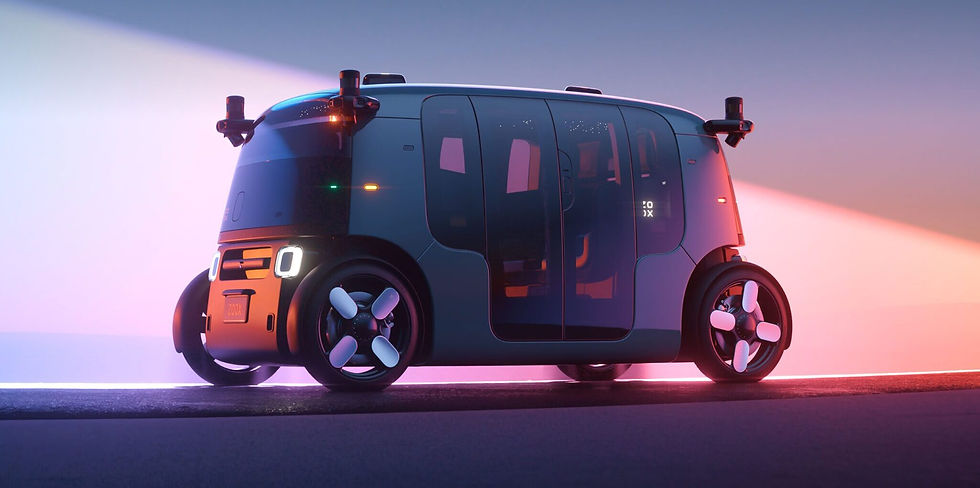
Instead of making a conventional car drive itself, Zoox designed an entirely new kind of vehicle around the assumption that nobody inside would ever need to drive it. The result is an all-electric, purpose-built autonomous robotaxi with no steering wheel, no brake pedal, no accelerator pedal and, wonderfully, no awkward moment when someone asks, “Wait, who's driving?” Nobody is. That is rather the point.
So What Exactly Is Zoox?
Zoox is an autonomous-vehicle company owned by Amazon, but describing it merely as a “self-driving car company” sells the concept short. The company is attempting to build an entire autonomous ride-hailing ecosystem around a vehicle engineered specifically for passengers rather than drivers. Amazon announced its agreement to acquire Zoox in June 2020, supporting a company that had been working on autonomous mobility since its founding in 2014. Instead of taking an existing sedan or SUV and filling it with computers, Zoox started with the question: what should transportation look like when the driver disappears completely?
It Is Not Really a Car — and Zoox Would Very Much Like You to Know That
Zoox itself uses the slogan “It’s not a car,” and for once the marketing department has a reasonable argument. Traditional autonomous vehicles still tend to resemble the automobiles we already know because they are based on conventional automotive platforms. Zoox’s robotaxi was designed from the ground up for autonomous ride-hailing. Its proportions, interior, controls—or rather lack of controls—and driving architecture are consequences of that decision. There is no driver’s seat because there is no driver. There is no conventional dashboard demanding that one passenger sit in command while everybody else becomes supporting cast. It is less “car of the future” and more “tiny private transit lounge that happens to move.”
The Interior Feels More Like a Tiny Lounge Than a Taxi
The disappearance of the driver completely changes the cabin. Zoox uses carriage-style seating, allowing riders to face one another rather than arranging everyone around a steering wheel. The vehicle can carry up to four passengers, creating something closer to an intimate mobile lounge than a standard taxi interior. Zoox describes the cabin as a social, living-room-like environment, and the design makes obvious sense once you remove the assumption that somebody needs to stare at the road while gripping a wheel. You can talk, look at your fellow passengers, check your phone, discuss dinner reservations, argue about whether ordering another bottle of champagne was financially responsible, or simply enjoy the surreal experience of being chauffeured by software.
And Yes, There Really Is No Steering Wheel
The steering-wheel situation deserves repeating because our brains have spent approximately a century believing that moving road vehicles should contain one. Zoox's purpose-built robotaxi does not rely on conventional human driving controls such as a steering wheel, accelerator or brake pedals. That design has even required Zoox to rethink mundane manufacturing procedures. For example, during vehicle alignment, technicians cannot simply position a physical steering wheel at center because there is no steering wheel to position. Zoox says its manufacturing process instead electronically sets the steering angle. Futuristic transportation, it turns out, still needs wheel alignment. Progress has its limits.
The Weirdest Trick? Zoox Does Not Really Have a Front
One of Zoox’s cleverest engineering decisions is bidirectional operation. The robotaxi is designed symmetrically and can operate in either direction without needing the traditional automotive distinction between a permanent front and rear. That matters because human drivers require a forward-facing control position; autonomous software does not. Removing that architectural requirement allowed Zoox to rethink both the exterior and interior of the vehicle. Instead of imagining a driverless version of a normal automobile, it effectively asked what shape makes sense for a machine whose passengers are cargo of the exceptionally opinionated, restaurant-reservation-making variety.

The Robotaxi Sees the World Differently Than You Do
A human driver has two eyes, three mirrors, varying amounts of caffeine and an unfortunate tendency to glance at a phone notification at precisely the wrong moment. Autonomous vehicles use sensor systems and computing instead. Zoox has designed its robotaxi around 360-degree perception, with its sensor architecture supporting awareness around the vehicle rather than relying on a driver's forward-facing perspective. Its symmetrical design complements this approach because the vehicle must understand its surroundings regardless of which direction it is traveling. The underlying challenge is enormous: pedestrians, bicycles, road construction, traffic lights, buses, unexpected lane behavior and the mysterious person who decides to cross six lanes because apparently destiny called. Zoox says dense urban environments are precisely the kinds of places its system is being designed to navigate.
Las Vegas Became the Perfect Place to Show It Off
If you were choosing a city to introduce passengers to a vehicle that looks like it escaped from a science-fiction film, Las Vegas is difficult to improve upon. On September 10, 2025, Zoox officially launched its ride service on and around the Las Vegas Strip, with rides accessible through the Zoox app. The company described the milestone as the launch of a fully autonomous ride-hailing service using a purpose-built robotaxi. Las Vegas therefore became something of a real-world showroom for a transportation concept that had previously looked suspiciously like something architects put into glossy renderings labeled “City of 2045.”
Zoox Is No Longer Just Circling a Test Track
By 2026, the program had expanded substantially. In March 2026, Zoox reported that its robotaxi fleet had accumulated nearly two million autonomous miles and carried more than 350,000 riders since the company's initial Las Vegas launch period. Zoox also announced continued expansion of its Las Vegas and San Francisco operations while deploying robotaxis in Austin and Miami. Those numbers come from Zoox itself, so they should naturally be interpreted as company-reported figures, but they nevertheless illustrate something important: this is no longer merely a concept vehicle occasionally appearing at technology demonstrations.
Where Can You Actually Ride Zoox?
As of August 2026, Zoox's own service information says its robotaxi is live in Las Vegas and San Francisco, although access differs by market. Las Vegas is the company's primary public ride market, while its community information describes San Francisco availability for select riders. Zoox also lists Austin and Miami among locations where its rollout is progressing. Because autonomous-service territories can change rapidly and usually operate within defined geographic zones, anyone planning to ride should check the current Zoox app or official service map rather than assuming a robotaxi will materialize everywhere from Miami Beach to your aunt’s driveway.
Regulators, Naturally, Had a Few Questions
Building a road vehicle without traditional human controls presents an obvious regulatory puzzle because motor-vehicle safety rules were largely written around vehicles designed for human drivers. The U.S. National Highway Traffic Safety Administration has consequently been deeply involved with Zoox's purpose-built vehicle. NHTSA issued a demonstration exemption covering Zoox purpose-built vehicles operating on U.S. public roads and simultaneously closed an investigation concerning the company’s earlier self-certification approach. The agency has also discussed Zoox's request for exemptions connected to commercial deployment, noting unusual design features including the absence of manual controls and mirrors, bidirectional operation and the unconventional seating arrangement. In other words, when you reinvent the automobile, somebody eventually has to reinvent the paperwork.
Zoox Versus Waymo: Same Destination, Very Different Philosophy
The fascinating thing about autonomous transportation is that companies can chase roughly the same goal while starting from completely different assumptions. Waymo's familiar approach has historically involved autonomous-driving technology integrated into recognizable automobile platforms. Zoox went much further architecturally by creating the vehicle itself around autonomy. That distinction may sound academic until you climb inside. In a conventional autonomous vehicle, you are still sitting in something designed around an absent driver. In Zoox, the absence of a driver is the design principle. The cabin, seating position, symmetry and controls all flow from it. Whether that eventually proves commercially superior is an open question, but aesthetically and conceptually, Zoox has unquestionably committed harder to the robotaxi idea.
Zoox Versus Tesla: Ownership Versus Transportation-as-a-Service
Tesla's autonomous-driving ambitions are associated primarily with vehicles that consumers buy and operate as personal automobiles, even as the company has articulated broader robotaxi ambitions. Zoox's core premise is different: mobility as a service. You do not necessarily need to own the sophisticated autonomous machine sitting outside. You request transportation when you need it, climb inside and leave the maintenance, parking, depreciation, insurance logistics and mysterious dashboard warning lights to somebody else. Amazon describes Zoox as an autonomous-driving ride-hailing service, reinforcing that service-oriented model.
Oddly Enough, That Could Make Zoox a Luxury Product
Luxury transportation has traditionally been associated with expensive objects: Bentleys, Rolls-Royces, Maybachs, private jets and yachts large enough to require their own zip code. But another definition of luxury is becoming increasingly important: removing friction. You do not necessarily want to drive. You want to arrive. You do not necessarily want more controls. You want fewer things demanding your attention. Viewed through that lens, an autonomous cabin becomes quite luxurious. The ultimate status feature may not be handcrafted paddle shifters or twenty-seven shades of leather. It may simply be having absolutely nothing to do with operating the vehicle.
The Real Luxury Feature Is Getting Your Time Back
Consider the absurdity of modern urban driving. We spend enormous sums buying vehicles capable of extraordinary performance, then operate them at eleven miles per hour while searching for parking. A robotaxi changes the value proposition. If autonomous transportation works safely and reliably at scale, commuting time becomes usable time. Twenty-five minutes can become twenty-five minutes for email, conversation, reading, entertainment or staring out the window contemplating why every meeting somehow could have been an email. Zoox's rider-centric cabin makes that transformation unusually visible because everything about the interior announces that your job is no longer to drive.
There Is Also Something Delightfully Antisocial About Not Having a Driver
Traditional premium chauffeur service comes with a human relationship. Usually a pleasant one, admittedly, but still a relationship. Do you chat? Stay silent? Sit in front? Sit in back? Apologize when your dinner reservation runs thirty minutes late? With a robotaxi, the etiquette problem disappears. The vehicle will not ask where you are from. It will not silently judge your nightclub destination. It will presumably remain emotionally stable when you change the drop-off point. For travelers accustomed to hotels where everything from lighting to room service can be summoned through an app, autonomous transportation is the logical extension of on-demand luxury.
Of Course, Trust Is the Billion-Dollar Question
A gorgeous cabin means very little if passengers do not trust the machine controlling it. Safety therefore remains the decisive issue for every autonomous vehicle company, including Zoox. The technological challenge is not merely producing a vehicle that drives impressively under ideal conditions. It must deal consistently with an almost comical variety of edge cases: construction zones, emergency vehicles, unusual road markings, cyclists, unpredictable pedestrians, weather, traffic conflicts and human drivers improvising rules that were definitely not in the handbook. Zoox says safety is foundational to its program, while regulatory oversight and real-world deployment continue alongside the technology's development.
Amazon's Involvement Makes This Experiment Much More Interesting
Zoox also has something most ambitious transportation startups desperately want: a parent company with extraordinarily deep resources. Amazon acquired Zoox in 2020 and has continued positioning autonomous transportation alongside its broader technology and robotics investments. Amazon CEO Andy Jassy wrote in April 2026 that Zoox was beginning commercial service while describing robotics and related technologies as areas where Amazon remained early in what it could build. That does not guarantee Zoox will dominate autonomous mobility—corporate history has buried many expensive moonshots—but it gives the company resources to pursue a technically demanding vision that may take years to scale.
And Zoox Is Already Redesigning Zoox
Perhaps the clearest sign that the project is moving beyond a one-off futuristic prototype is that Zoox introduced an updated robotaxi design in June 2026. The company described the revised vehicle as the foundation for bringing autonomous ride-hailing to more passengers and greater scale. That is a revealing shift. The first challenge in advanced technology is making something astonishing work once. The second—and vastly less glamorous—challenge is manufacturing enough of them, maintaining them, operating fleets, supporting passengers and doing all of it economically. A robotaxi becomes genuinely disruptive only when it stops being exotic.
Imagine What Happens When This Becomes Normal
The most interesting future for Zoox is not one where people endlessly photograph the robotaxi because it looks unusual. Success would mean eventually finding it boring. You finish dinner, open an app, request a vehicle and a silent electric pod arrives. The doors open. Four people climb into their little mobile lounge. Nobody checks whether somebody is sober enough to drive. Nobody searches for parking. Nobody circles the block. Nobody tips a valet twenty dollars for retrieving a car that was sitting seventy feet away. The robot simply takes you somewhere else.
That Could Change Cities, Not Just Cars
If autonomous ride-hailing eventually reaches large-scale adoption, the implications could extend beyond the vehicle itself. Urban spaces currently devote extraordinary amounts of physical real estate to parked automobiles, parking structures, loading areas and vehicle circulation. Shared autonomous fleets could potentially alter how frequently individually owned cars sit unused, though the ultimate effects on congestion will depend on how such services are deployed and whether they replace personal-car trips, public transportation, walking or other modes. Zoox argues that autonomous mobility can contribute to safer, cleaner and more efficient transportation, but the final urban impact will be determined by behavior and policy as much as engineering.
Zoox is compelling because it forces us to rethink something we stopped questioning decades ago. Why does every passenger vehicle need to be designed around a human operator? Why should seats always face forward? Why should a vehicle have a permanent front? Why should transportation require our attention at all?
Perhaps the next generation of luxury mobility will not be defined by how enjoyable a machine is to drive. Perhaps luxury will mean not having to drive in the first place. No steering wheel. No pedals. No designated driver. No parking hunt. No valet line. Just four seats, a destination and an extremely sophisticated robot quietly handling the unpleasant part. The future of transportation, apparently, is a toaster-shaped lounge on wheels. And somehow, that sounds rather fabulous.
Experience More of the Extraordinary
From futuristic transportation and private aviation to extraordinary hotels, supercars, yachts, technology, destinations and the finer machinery of modern life, explore more stories devoted to living exceptionally.
Discover the world of luxury at diaani.com/lux-life
References
Zoox — Official Website. “Zoox: It’s Not a Car.” Company overview and purpose-built autonomous robotaxi information.
Zoox Journal. “Zoox Robotaxi Launches in Las Vegas,” September 10, 2025. Details on the company's Las Vegas public ride-hailing launch.
Zoox Journal. “The Design Architecture of the Zoox Robotaxi,” February 19, 2026. Discussion of the vehicle’s purpose-built architecture and design philosophy.
Zoox Journal. “360° Autonomous Vehicle Perception,” April 9, 2026. Details on bidirectional design, cabin layout and perception architecture.
Zoox Journal. “Zoox Expands Robotaxi Service and Unveils New Product,” March 23, 2026. Company-reported autonomous mileage, ridership and expansion information.
Zoox Journal. “Introducing Our Next Zoox Robotaxi Design,” June 24, 2026. Information regarding the updated robotaxi platform and plans for scaling service.
Zoox. “Where to Ride.” Current service and upcoming-market information.
Zoox. “Zoox in Your Community.” Public availability and safety information.
National Highway Traffic Safety Administration. “NHTSA Issues First-Ever Demonstration Exemption to American-Built Automated Vehicles.” Federal regulatory information concerning Zoox purpose-built autonomous vehicles.
National Highway Traffic Safety Administration. National AV Safety Forum materials discussing Zoox’s autonomous vehicle design and regulatory exemption request.
Amazon. “We’re Acquiring Zoox to Help Bring Their Vision of Autonomous Ride-Hailing to Reality,” June 26, 2020. Background on Amazon’s acquisition of Zoox.
Amazon. “Take a Ride in a Zoox Car at the Headquarters in California.” Description of the robotaxi, four-passenger capacity and rider-focused design.
Amazon. Andy Jassy’s 2025 Letter to Shareholders, published April 9, 2026. Discussion of Zoox commercial service and Amazon’s broader robotics initiatives.
Service areas, regulatory status and autonomous-vehicle programs evolve quickly. Availability and program details referenced in this article reflect information available as of August 11, 2026.
Zoox, Zoox robotaxi, Amazon Zoox, Zoox autonomous vehicle, Zoox self-driving car, Zoox driverless taxi, Zoox Las Vegas, Zoox San Francisco, Zoox robotaxi price, how does Zoox work, can you ride Zoox, where is Zoox available, Zoox vs Waymo, Zoox vs Tesla, Amazon self-driving car, autonomous robotaxi, driverless luxury car, future of transportation, autonomous ride-hailing, electric robotaxi, self-driving taxi, luxury autonomous vehicle, bidirectional vehicle, car without steering wheel, car without pedals, purpose-built robotaxi, future luxury travel, AI transportation, Zoox app, Zoox interior, Zoox safety, is Zoox available to the public, what is Zoox, who owns Zoox, how to ride Zoox


Comments